The Cypro-Syllabic Script: A Legacy of Ancient Cyprus
Cyprus was once a crossroads for many different civilizations, each bringing its own unique culture and traditions. Language, a fundamental pillar of culture, evolved significantly as these groups interacted. Over time, these cultural exchanges led to the creation of new communication systems, most notably the Cypro-syllabic script.
Origins and Structure
This writing system is a descendant of Cypro-Minoan, the island's oldest script, dating back to the 16th century BCE. Cypro-Minoan itself is closely related to Linear A, the yet-undeciphered script of the Minoan civilization on the island of Crete. While the earliest readable inscriptions date back to the 11th century BCE, containing early Greek names, the script reached its peak of widespread use between the 7th and 4th centuries BCE (Steele, 2019).
The Cypro-syllabic system is structured around symbols representing either standalone vowels or combinations of consonants and vowels. Unlike many modern scripts, it was typically written and read from right to left. The modern understanding of this system dates back nearly 200 years. In 1850, the French collector, the Duke of Luynes, first proposed that this was a unique system specific to Cyprus, based on his study of the famous Idalion Bronze Tablet in the Cyprus Museum (Kyprios Character, n.d.).
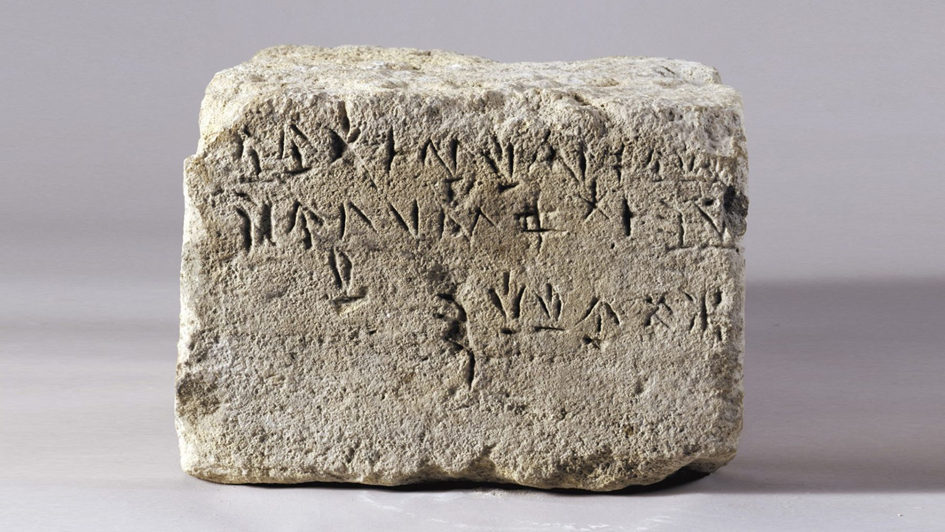
Cypro-syllabic inscription or artifact related to the Cyprus Museum collectionEgetmeyer, M. (2013).
Egetmeyer, M. (2013).
Cultural Significance and Royal Power
The script was used to record various languages, including the Arcadocypriot dialect of Greek and the indigenous Eteocypriot language. For the people of Cyprus, this writing system was more than just a tool; it was a symbol of political identity and traditional values. During the Iron Age, the script effectively became a "royal monopoly." Cypriot kings used it as an official instrument to assert their unique identity and power, making it the primary script for royal coinage and administrative documents (Steele, 2019).
This deep cultural and political connection is why the islanders continued to use it long after other regions had transitioned to alphabetic systems. The script can be especially examined on a funerary stele. The breakthrough in deciphering it occurred in 1871, when Robert Hamilton Lang identified the word for "King" (Basileus) on ancient coins, initiating a decoding process that was largely completed by the mid-1870s (Kyprios Character, n.d.).
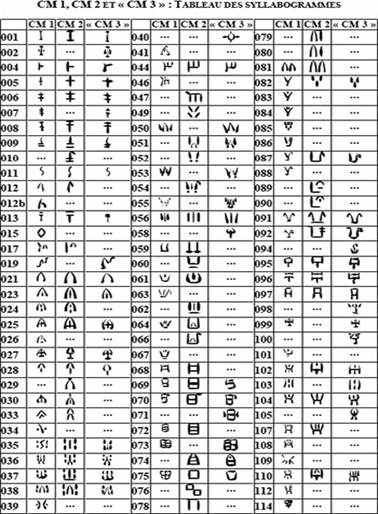
Ancient Cypriot coin, funerary stele, or inscription connected to the decipherment of the Cypro-syllabic script
A Lasting Mystery and Global Presence
While much of the linguistic system remains a mystery today, approximately 1,360 to 1,400 inscriptions have been identified to date, with new discoveries continuing to update this number (Steele, 2019). Some of the surviving examples are preserved and displayed at the Cyprus Museum in Nicosia.
The legacy of the script extends far beyond the island's shores. In the 4th century BCE, Cypriot mercenaries hired by Egyptian pharaohs left inscriptions on the walls of temples in Abydos and Karnak, marking the script's presence deep within Egypt (Kyprios Character, n.d.). Today, due to centuries of antiquity trading, these inscriptions are scattered across 34 different museums worldwide, serving as a testament to the island's rich, complex, and internationally connected history.
Cyprus Museum. (n.d.). Permanent collection of the Cypro-Syllabic inscriptions. Nicosia, Cyprus.
Egetmeyer, M. (2013). From the Cypro-Minoan to the Cypro-Greek syllabaries: Linguistic remarks on the script reform. In P. M. Steele (Ed.), Syllabic Writing on Cyprus and its Context (pp. 107-132). Cambridge: Cambridge University Press. doi:10.1017/CBO9781139208482.007
Kyprios Character. (n.d.). Corpus of Cypriote syllabic inscriptions of the 1st millennium BC. Retrieved from https://kyprioscharacter.eie.gr/en/scientific-texts/details/inscriptions/corpus-of-cypriote-syllabic-inscriptions-of-1st-mill-bc
Nakou, C. (n.d.). The Cypro-Syllabic script [Workshop description]. Retrieved from https://www.google.com/search?q=https://christinanakou.gr/workshops/%25CF%2583%25CF%2585%25CE%25BD%25CE%25BF%25CE%25BC%25CE%25B9%25CE%25BB%25CF%2589%25CE%25BD%25CF%2584%25CE%25B1%25CF%2582-%25CE%25BC%25CE%25B5-%25CF%2584%25CE%25AF%25CE%25BF-%25CE%25BA%25CF%2585%25CF%2580%25CF%2581%25CE%25B9%25CE%25B1%25CE%25BA%25CE%25BF-%25CF%2583%25CF%2585%25CE%25BB%25CE%25BB%25CE%25B1%25CE%25B2%25CE%25B1%25CF%2581/
Steele, P. M. (2019). [Review of the book Inscriptions syllabiques chypriotes (ISC), by J.-B. Cayla]. American Journal of Archaeology, 123(4). Retrieved from https://ajaonline.org/book-review/1867/