Ersin Tatar’s Double Standard: Free Speech for the Few?
On holding leaders, universities and the public accountable. An exposé.
Despite emails of protest delivered to St. John’s College, on Monday, November 20th, Oxford University’s Turkish Society hosted a polemic event – a talk by the self-titled ‘President of the Turkish Republic of Northern Cyprus’, right-wing nationalist Mr. Ersin Tatar, about ‘The Way Forward in Cyprus’, followed by a Q&A.
This event stirred controversy from the start. The Turkish Society’s decision to refer to the Turkish Cypriot community leader as ‘President’ and to Northern Cyprus as ‘The Turkish Republic of Northern Cyprus’ was unsurprising considering Turkiye’s insistence on the term. Still, it reflected a disregard of the professional guidelines agreed upon by journalists on both sides of the divide, as published in ‘Words That Matter: A Glossary for Journalism in Cyprus’ and, of course, of international law; the execution and timing of the event –just two days after the fortieth anniversary of United Nation’s decision to declare the ‘TRNC’s’ ‘establishment’ as ‘legally invalid’ too, was provocative.
The talk sparked some online student activism within the wider Greek-Cypriot community, with the far-right @metopouk published the following call for action Instagram (
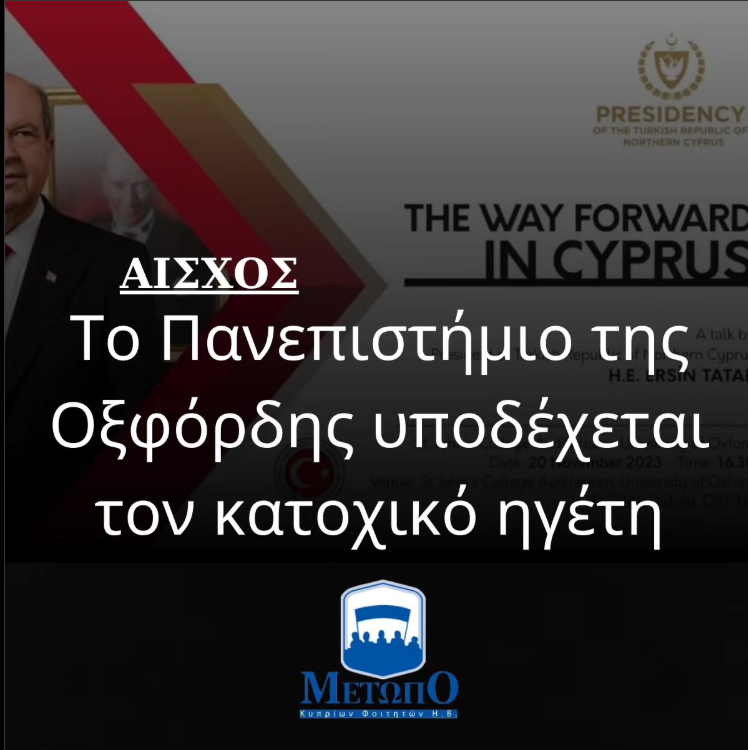
Ανάρτηση του Μετώπου για την υποδοχή του Έρσιν Τατάρ από το Πανεπιστήμιο Οξφόρδης
metopouk
A post shared by @metopouk
) and the more centrist and democratic @cyprusyouthdiplomacy reposting the event on their story with a caption that stressed the self-styled republic’s illegality. @efek_uk – late to the discourse, also published a call for action and publicised an email they sent to Oxford University’s Student Union.
In liberal Oxford, some efforts were made to take the event off university premises, but public consensus was that the event should take place, on the basis of free speech. Determined to provide some alternative perspectives to Tatar and Turkiye’s official narrative about Cyprus three (Greek-)Cypriot students, myself included attempted to attend the event.
Attendance was by registration only, so we disclosed our full names and Oxford University email addresses to the society’s sign-up form, the day prior. To our surprise, just hours before the event, we all received the same email, denying us entrance to the talk on the grounds of ‘oversubscription’.
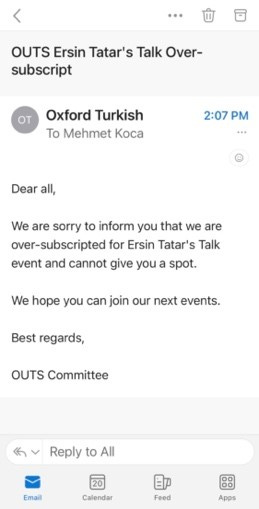
Email from Oxford University’s Turkish Society, denying entrance to the talk on the grounds of “oversubscription”.
The Cyprus issue merits a place in global public discourse, especially in the UK, whose withdrawal from the island amidst a divide and rule strategy fuelled the flames of war and inter-communal unrest. Like Israel-Palestine, it cannot be solved without international support and pressure. So, in some ways I felt hopeful that so many people showed an interest in my little island’s current affairs, albeit in a narrative about it that I find deeply problematic: Mr. Tatar, backed by Turkiye’s Erdogan, is the only leader to successfully platform a two-state solution in Cyprus since the country’s partition and, in October 2020, started his term in office amidst reports of vote-buying https://www.docdroid.net/fwz15Zt/report-on-interference-presidential-elections-cyprus-northern-pdf and https://www.theguardian.com/world/2020/nov/15/erdogan-met-by-protests-from-turkish-cypriots-during-visit-northern-cyprus .
Disheartened as we were, that Ersin Tatar could be the only Cypriot voice in attendance, we headed to St. John’s Auditorium anyway, hopeful that there would be a few last-minute no-shows, and that we would be let in.
Upon arrival, we were asked to add our names to a printed version of the guest list, on which they were not included. While a total of six attendees were denied entrance, we were the only ones to have registered for the event in due-notice, and the only ones to have received an email that denied us entry.
As indicated by the photo evidence attached, more than half the seats in St. John’s Auditorium were empty. We were, by now, suspicious that our exclusion from the event was less a matter of capacity, and more a strategic attempt to eliminate political opposition from the audience. In other words, a presumption of our political affiliation due to the ethnic-background associates with our names, and thereby an act of exclusion on the grounds of ethnic and/or national identity.
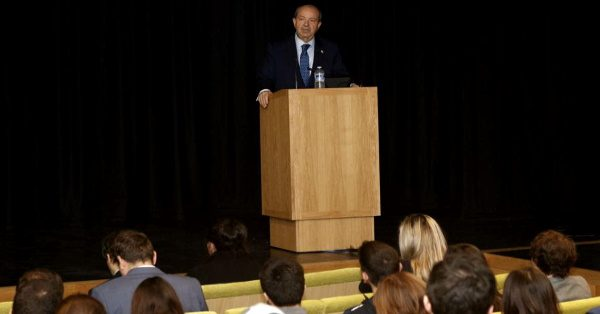
Πάνω από τις μισές θέσεις στην αίθουσα της Οξφόρδης ήταν άδειες.
A Greek-Cypriot student acquainted with one of the organisers directly addresses them, calmly, but with intent: ‘I know you’re lying to me’.
‘Is this room full? Is this room full?’, she asks.
For nearly an hour, we received only baffled responses and convoluted justifications for our exclusion, in response to this line of questioning. By 5.30 pm, almost everyone denied entry had left.
I chose to wait outside a while longer; I spent my time trying to convince Turkish Society members to plan a second, Cyprus-related event in the form of a panel, as to democratise the discourse around the Cyprus issue and provide a platform to pro-federation voices as well.
While I was waiting outside, the President of Oxford University’s Turkish Society and an Oxford Brookes Professor who helped organise the talk, came to meet me. The President of Turkish Society explains that Tatar’s team had asked to look over the sign-up list prior to the event, and had censored Tatar’s audience, on the grounds of ‘security’.
Our suspicions were confirmed: The only three Greek-Cypriots that had registered for the event in advance were denied entrance under the guise of oversubscription. None of us carry a criminal record, none of us are affiliated with any extremist group, and we all pertain to distinct social circles in Cyprus. The only commonality – the association of our names with a distinct ethnic background and country.
Did our Greek-Cypriot identity signal some primitive inability to take part in civilised discussion? Or perhaps it was our affiliation with Cyprus? Why was Tatar so terrified of three twenty year old university students? Is it because we might have first-hand experiences of the political and economic climate in Northern Cyprus, or feel unaffected by the threat of Turkish media censorship? Because we might have interacted with the Turkish Cypriot hoi polloi suffering today because of Turkish interference on the island, and with a community slowly fading into disappearance because of Turkiye’s attempts to skew population demographics on the island.
I voiced, regrettably, only a fraction of these concerns to the event’s organisers and received only apologies in response. The Brookes Professor co-organising the event tried to justify the Society’s discrimination on the grounds that this was common practice for high-profile events, but this is, at best, a weak argument. Do the Oxford Union or Diplomatic society censor their audiences? For the sake of the university’s integrity and of democratic dialogue everywhere, I hope not.
Throughout our exchange, one question echoes in my head. Why would they be admitting this to me?
I later discovered that a Turkish Society committee-member had pushed for the truth to be revealed, from inside of the event. This same committee member offered to read out a question on my behalf, during the Questions and Answers session which followed. In their attempt to do so, they experienced further attempts at censorship, and were repeatedly asked whether my question had been vetted. As a result of the committee member’s insistence, I was allowed entry to the final fifteen minutes of the event, where commented on my exclusion, and voiced perspectives that had not been previously considered.
As tends to be the case when one is the only person of a specific cultural group in the room, I became subject to a process whereby my words were misinterpreted, and the official rhetoric of my community was assumed as my own.
I interrupted Ersin Tatar when he started to describe the war of 1974 as a ‘peace operation’ and was subsequently associated with the acts of terror committed by select groups of the Greek-Cypriot community, in the fifties and sixties. Several other audience members subsequently intervened, asserting that it wasn’t in ‘my’ interest to discuss the past, and that I wasn’t participating in the discourse ‘democratically’. In hindsight, the discourse was far more civil than many parliament debates and to this day, I feel I was acting the moral duty to challenge the status-quo and to resist state-serving narratives of the past.
Oxford University’s commitment to free speech is renowned and regularly reinforced via invitations to polemical speakers, and the gruelling questioning of said speakers by moderators and audience members alike. If Russian diplomats and former Israeli prime ministers can defend their politics against opposing views and amidst activist interventions in Oxford, then so should Ersin Tatar. Further yet, if Mr. Tatar hopes to be received as a legitimate and democratically elected leader, then he should expect to be held accountable to the same standards, especially as he attempts legitimise the ‘TRNC’s’ position as state on the global stage.
Tatar’s talk at Oxford , which occurred a mere four days after anniversary of Northern Cyprus’s self-declaration of independence (accepted only by Turkiye), is inseparable from the Turkish-Cypriot leadership’s aim to lobby the international community, and Downing Street in particular, toward international legitimacy for the ‘TRNC’. The UK is of key geopolitical importance to Cypriot peace-negotiations since it forms one third of the country’s guarantor powers (as per the Cypriot constitution) and is the only guarantor power with a claim to neutrality. (The other two are Turkey and Greece.) It’s no coincidence that since assuming power in 2020, Tatar has consistently chosen the UK as the destination for his annual celebrations of Northern Cyprus’s ‘independence’. It does, however, seem ironic that in his attempt to achieve the United Kingdom’s favour and regularise the illegal occupation of Northern Cyprus, Mr. Tatar has discriminated on the grounds of ethnic/cultural association, thus creating plausible grounds for the violation of another law, this time local to the United Kingdom – the 2010 Equality Act. Accordingly, holding Mr. Tatar accountable could strain his relationship with the very politicians he is trying to win over and prove deeply politically damaging instead.
The absence of any public outrage about Ersin Tatar’s audience censorship also carries painful implications about the state of Cyprus’s political discourse, or lack thereof. Over the past three years, Ersin Tatar has visited Cambridge University, Kings College London, and Imperial, in the listed order, each at around the time of the Northern Cyprus’s ‘Independence Day’. While his presence at KCL was more of a meet-and-greet with a select few, an invitation-only event taking place at the Turkish Embassy, Tatar’s display of audience censorship at Oxford raises concern over whether his audiences at Cambridge and Imperial, and at most public events abroad, are also censored. If so, why has there been so little media coverage? Has no Greek-Cypriot attempted to attend any of these events? Could we really be so disinterested in political dialogue, so unwilling to listen to an alternative narrative, and so hesitant to express our views beyond the safety of our own little echo chambers?