Alashiya: A letter, Two Languages and a Mystery Waiting to be Unraveled
Imagine finding a secret letter your grandmother wrote and hid for you, but you don’t understand a word of it. Why did she write it in a different language? What is she trying to tell you?
Alashiya is a game-based learning tool developed by the European Union Linguistic Support Project, which has been implemented since 2020 under the EU Aid Programme for the Turkish Cypriot community. Our project aims to raise awareness, particularly among Cypriot youth, about the linguistic and cultural wealth of our island; to spark an interest in learning each other’s languages; to bring Turkish Cypriots closer to the European Union; and to help build stronger ties between the two communities. Alashiya was developed by our project as a game-based learning tool to promote Cyprus’s linguistic heritage in line with these objectives. Our project team is quite small; apart from the services we outsourced during game development, we are just a team of two.
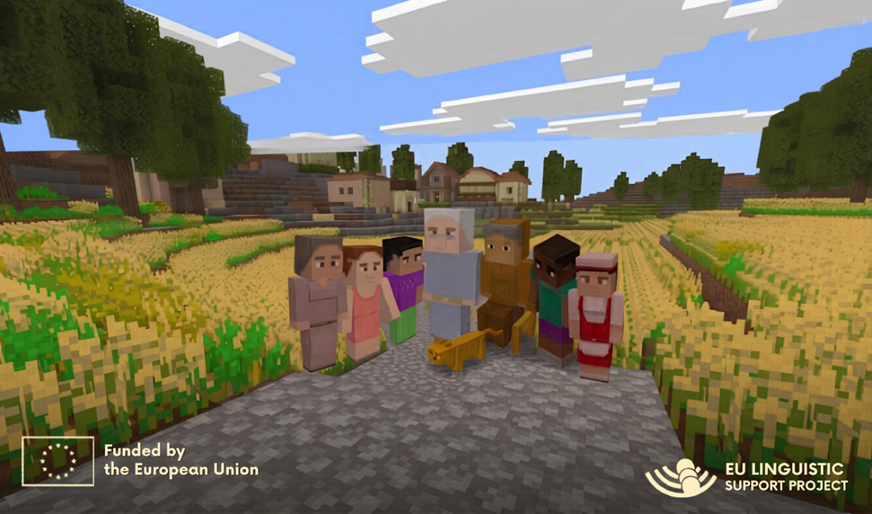
Alashiya is based on the video-game Minecraft, which has been extremely popular worldwide, especially among children and young people over the past 10 to 15 years. The game’s objective is to showcase the uniqueness and diversity the two dialects spoken on the island—Cypriot Turkish and Cypriot Greek—while also introducing other languages and dialects that have contributed to Cyprus’s linguistic and cultural fabric for centuries, such as Armenian, Cypriot Arabic (Sanna), and Gurbetcha[1]. The game has two versions, one playable in Cypriot Turkish and the other in Cypriot Greek. The version developed for Cypriot Greek-speaking players aims to teach them certain Cypriot Turkish words and expressions, while the Cypriot Turkish version aims to teach the same words and expressions in Cypriot Greek. In other words, players will not experience Alashiya in standard Greek or Turkish, but in the dialects spoken on the island.
[1] There is no dubbing in the game; its content consists of written dialogues and texts.
Alashiya does not intend to teach these dialects or languages to its target audience; in other words, it does not aim to bring players to a specific linguistic proficiency level. Its goal is to highlight the linguistic diversity of our island and, specifically, the unique features of Cypriot Turkish and Cypriot Greek. Therefore, the words and expressions players will encounter throughout the game are the sort an average Cypriot might need when speaking with others during everyday conversation.
Now let’s talk a bit about the game’s story. Set in Cyprus, this adventure begins when the game’s main character, Dofi, decides to have a letter translated that they found inside a time capsule at their recently deceased grandmother’s house. The letter is addressed to her grandchild. For Turkish Cypriot players, the letter is in Cypriot Greek; for Greek Cypriot players, it is in Cypriot Turkish. Dofi is surprised that their grandmother is bilingual and sets out on a journey to find out what the letter says. During this journey, Dofi meets both the grandmother’s closest friends as well as characters representing our island’s multilingual and multicultural fabric, and by the end of the day, they succeed in having the letter translated in the villages they visit. In doing so, they learn some new words and expressions, as mentioned above.
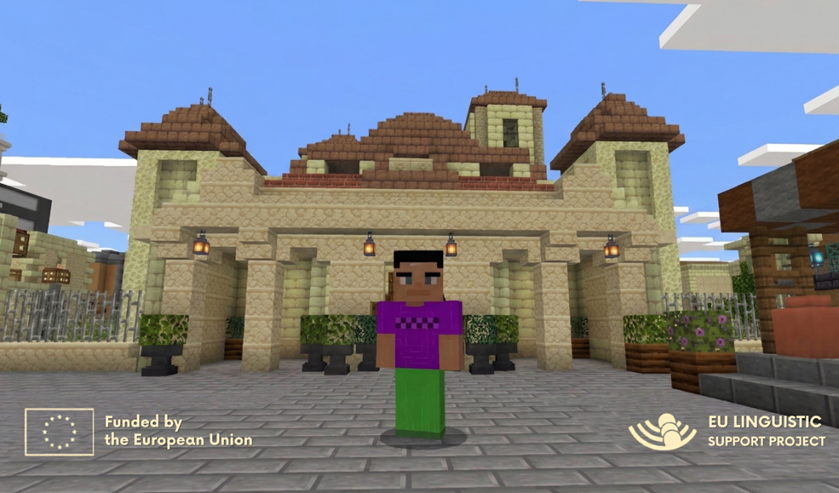
The game, which consists of a total of five levels excluding the prologue, begins and ends in Nicosia, the city where Dofi and their family live. Along the way, Dofi visits Kritou Terra, Kormakitis, Armenohori, and Rizokarpaso, while seizing the opportunity to see some of the island’s cultural and historical sites and to learn about them. In addition to Greek Cypriot and Turkish Cypriot characters, there are Maronites in Kormakitis, Cypriot Armenians in Armenohori, Afro-Cypriots in Rizokarpaso, Latins near Salamis Ruins and Gurbets in Nicosia. The game is designed so that players can learn approximately 30–40 words or expressions per level regardless of their gaming skills. After completing the Prologue, players reach the end of the game by taking the quizzes at the end of all other villages each representing a level in the game, plus the final level which brings Dofi back to their hometown, Nicosia. Once the main story of the game concludes, players are free to explore the island as much as they like.
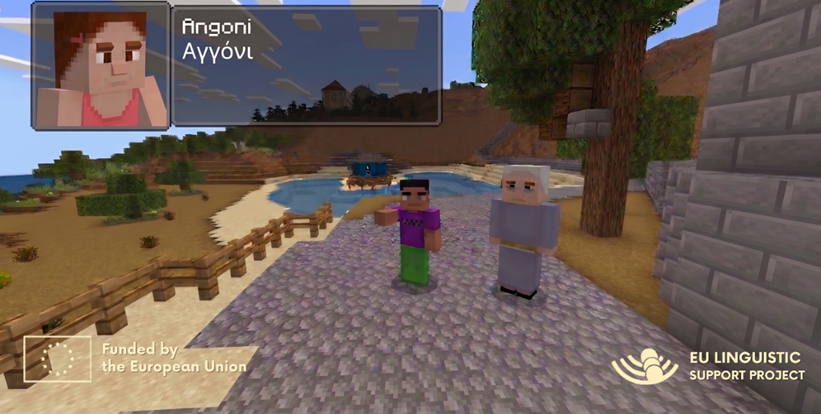
Once players log in and start the game, they can explore the Cyprus-inspired Minecraft world freely after the Prologue. Put differently, there is no obligation to follow the main story or the suggested map, but to achieve the game’s primary objective and experience the main and side quests, the players need to follow the main story. Additionally, considering that the gameplay mechanics we’re familiar with in Minecraft—such as building or crafting—are not present, we can describe Alashiya primarily as an educational tool.
Since Alashiya was developed based on Minecraft, access to the game is provided through Minecraft Education. This means that anyone with Minecraft Education credentials can play this game and all other games on the platform as many times as they like, so long as their license is valid. We have noticed that most educational institutions—at least private schools—attended by children aged 10–16, our primary target audience, hold these licenses and hence provide access to this platform to their students. Moreover, we have a limited number of ready-to-use licenses available, awaiting their owners. We tested the pilot version of Alashiya in the buffer zone on January 31, 2026, with a small group of Turkish Cypriot and Greek Cypriot children aged 12–14. Based on the very positive and constructive feedback received at this pilot run, we fine-tuned its content and finalized the game.
The EU Linguistic Support Project has been underway for almost six years and the current phase of implementation will continue until the end of February 2027. During the remaining lifecycle of the project, we will focus on promoting the game through various channels in both communities, particularly targeting Cypriot youth. To serve this purpose, we are planning to launch a dedicated website for Alashiya in the near future. Everyone will be able to visit this website, learn about the game, and even download it—though, as mentioned earlier, access to Minecraft Education will be required to play the game. In addition to promoting the game through its dedicated website, we will intensify our visibility activities through other channels, such as traditional media, our project’s social media pages, and relevant events and festivals.
If you would like to know more about our game or our project in general or if you wish to explore and discover the world of Alashiya, please contact us via our project’s social media pages or send an email to sezin.tekin@particip.com and/or erdim.turkmen@particip.com. You can access our project’s social media pages using the links below: